Lipinski´s Rule of 5
In 1997 Christopher Lipinski from Pfizer found a simple mnemonic which he called the "Rule of 5" because the parameter cut-off values all contained 5's. Numerically there actually are only four rules. This was a major breakthrough for the chemInformatic society. The Rule of 5 stated:
Poor absorption or permeation are more likely when there are:
1) More than 5 H-bond donors
2) The molecular weight is over 500
3) The CLog P is over 5 (or MLOGP is over 4.15)
4) The sum of N's and O's is over 10
Substrates for transporters and natural products are exceptions.
The rule is useful but it has some limitations. Some of today’s blockbusters fail by using that rule. It is too simple to detect all patterns of drugs. For further development’s, see expert systems for selecting molecules ==> Lead optimisation and drug-candidate selection
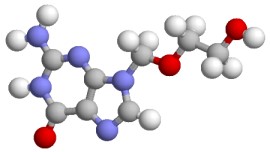
Example: Aciclovir
H-donors : 4
MW: 225.21
MLOGP: -0.09 (exp. LogP: -1.56)
H-acceptors : 8
Aciclovir would pass the Rule of 5.
Literature:
Lipinski, C. A., Lombardo, F., Dominy, B. W., Feeney, P. J. Experimental and computational approaches to estimate solubility and permeability in drug discovery and development settings.
Adv. Drug Delivery Rev. 23, 1997, 3-25.
Lipinski, C. A. Drug-like properties and the causes of poor solubility and poor permeability.
J. Pharm. Tox. Meth. 44, 2000, 235-249.
Recent News:
PharmaInformatic and UNIZYME Laboratories sign cooperation agreement:
Selection and prioritisation of lead compounds for the treatment of autoimmune and inflammatory diseases based on estimated oral bioavailability in humans with IMPACT-F (more).
Can IMPACT-F predict human oral bioavailability of entirely new molecules (NCEs)?
Read the answer here.
LEAD
OPTIMIZATION
with
IMPACT-F:
==> selects oral bioavailable
drugs
==> increases efficacy of clinical trials
==> results
directly available
Only compound structure needed
==> no further assays, synthesis
or costs
 |
 |
 |
 |
 |



|
|











|
© Copyright 2004-2021 PharmaInformatic Boomgaarden. All rights reserved. Site map Contact Terms of Use Imprint |

By using our platform technology, we can detect relationships between complex molecular patterns and properties of molecules.
IMPACT-F calculates oral bioavailability in humans much more precisely
than animal trials.
 |
Bioavailability prediction helps to reduces failures
in clinical trials.